





Your Pet Dressed as a King Isn't an Internet Fad. It's a Centuries-Old Tradition
A dog dressed as a duke feels like a very modern joke. It isn't. People have been turning animals into characters for centuries, and the story is stranger than you'd think.
Furface Studio · October 12, 2026 · 8 min read
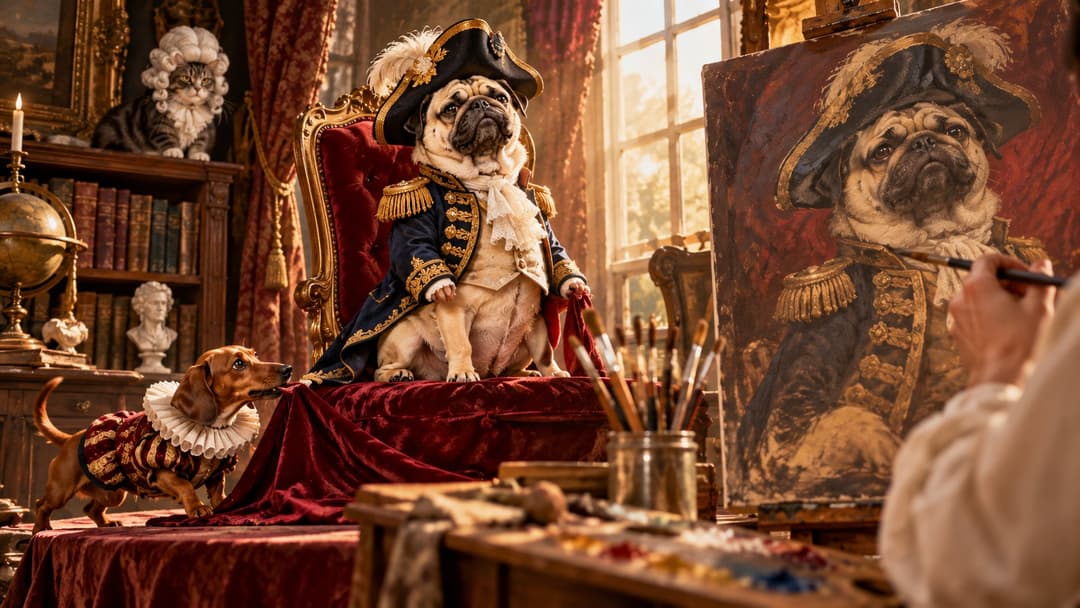
Scroll through any social feed for long enough and you'll meet him: a pug in a ruff and velvet doublet, gazing out of an oil painting like a minor Tudor duke. Or a cat as a Napoleonic general. Or a spaniel in a judge's wig.
It feels like a very modern joke, the kind of thing the internet invented sometime around the arrival of smartphones.
It isn't. People have been dressing animals up as people, painting them as people and gently mocking themselves through them for at least three hundred years. Along the way, the tradition produced a queen's favorite painter, a poodle judge, a Victorian taxidermist with a kittens' wedding, a man who drew cats so well that H.G. Wells said English cats were ashamed not to look like his, and a set of cigar advertisements that became some of the most famous paintings in America.
Here's how we got from there to your dog in a crown.
It started with monkeys in wigs
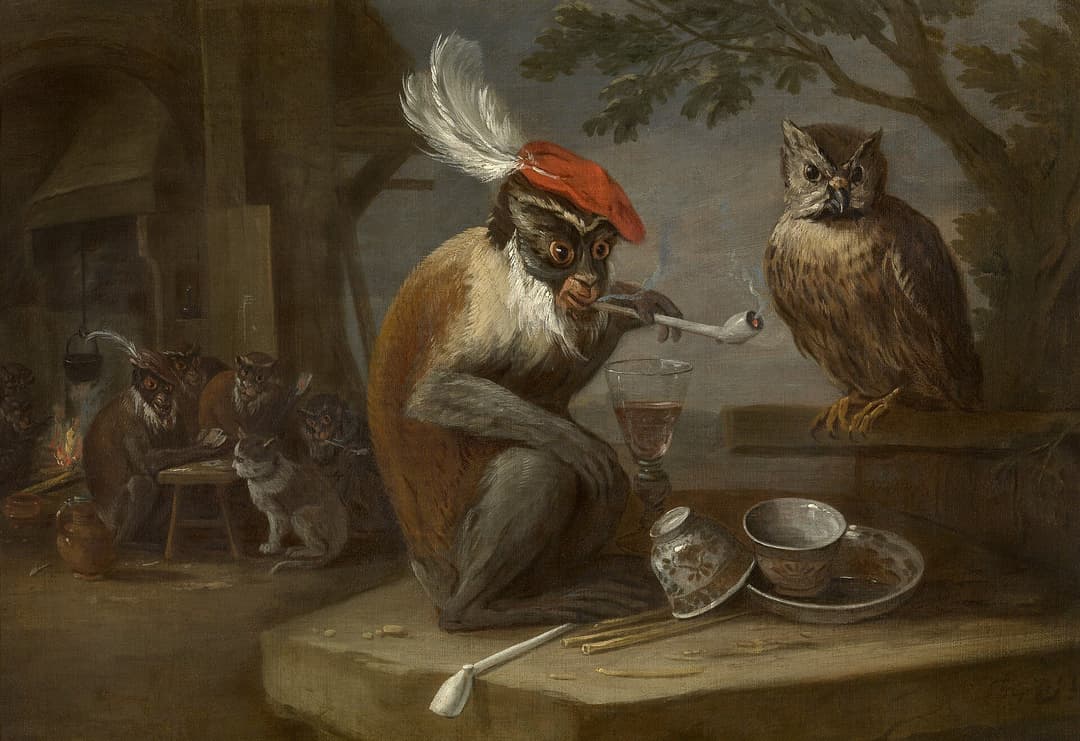
Before anyone dressed up their pets, they dressed up monkeys.
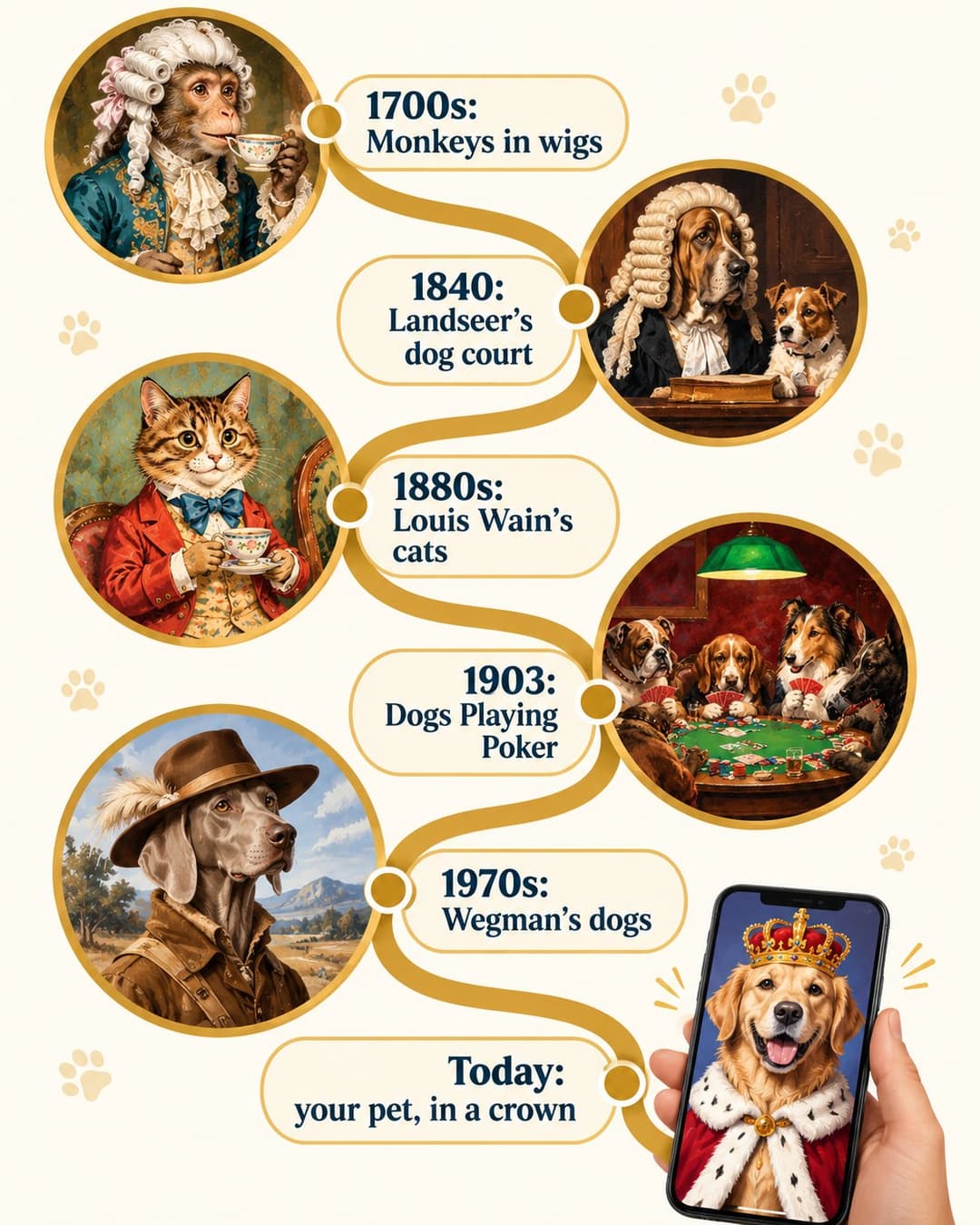
In the 1600s, Flemish painters began producing pictures of monkeys doing human things: drinking in taverns, playing cards, getting their hair done. By the early 1700s, the fashion had a name in France: singerie, roughly "monkey business." Around 1737, the artist Christophe Huet covered a small room at the Château de Chantilly, near Paris, with monkeys in fashionable clothes hunting, dancing, playing music and generally behaving like aristocrats.
The joke wasn't really about monkeys. It was about us. A monkey in a powdered wig, fussing over its reflection, let painters poke fun at human vanity without naming anyone in particular. Hold onto that idea, because it never really goes away: when we put animals in human clothes, we're usually saying something about ourselves.
A queen, her spaniel and the painter who gave dogs feelings
The real turning point came in Victorian Britain, and it involved actual pets.
Queen Victoria adored dogs, and owned them in industrial quantities. By 1839, her prime minister, Lord Melbourne, was joking that she risked being "smothered" by them. Decades later, a visitor counted 55 dogs in the kennels at Windsor Castle. One of her favorites as a young woman was Dash, a King Charles spaniel, and in 1836 he was painted by Edwin Landseer, who became the most famous animal painter of the age.
Landseer pushed something further than anyone before him. Plenty of earlier painters had treated dogs as accessories, or as hunting equipment that happened to have fur. Landseer painted them as personalities, with expressions, moods and opinions. His 1839 picture Dignity and Impudence shows a vast, solemn bloodhound and a tiny, cheeky terrier peering out of the same kennel, and everybody who looks at it knows exactly what each dog is thinking.
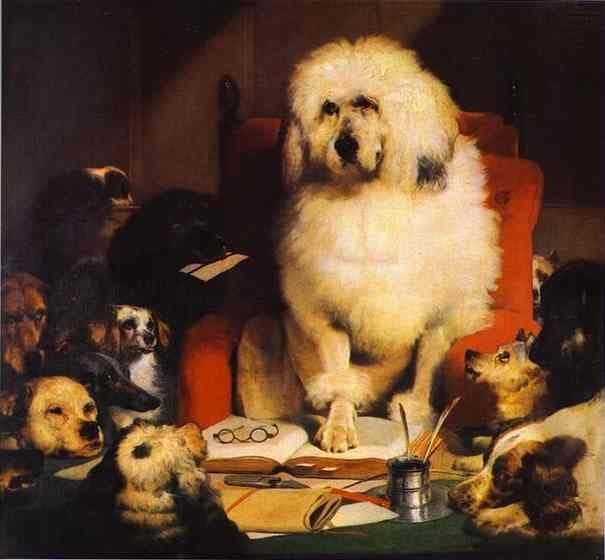
Then he went further. In 1840, he exhibited Laying Down the Law: a courtroom made entirely of dogs, with a French poodle presiding as the Lord Chancellor. The idea apparently came from a judge at a dinner party, who remarked that a friend's poodle "would make a capital Lord Chancellor." When the Duke of Devonshire bought the painting, he had Landseer add his own spaniel to the scene.
Notice what happened there. A rich man looked at a painting of dogs dressed as lawyers and said, in effect, "Can you put my dog in it?" That's the whole modern pet-portrait business in one sentence, 185 years early.
Landseer's work was reproduced as engravings and spread far beyond palaces. Britain was falling in love with the idea that a dog had a character worth recording. Within a couple of decades the first dog shows were being held, pet-keeping was booming, and the pet portrait had arrived.
The man who taught cats to stand up
If Landseer gave dogs feelings, Louis Wain gave cats whole lives.
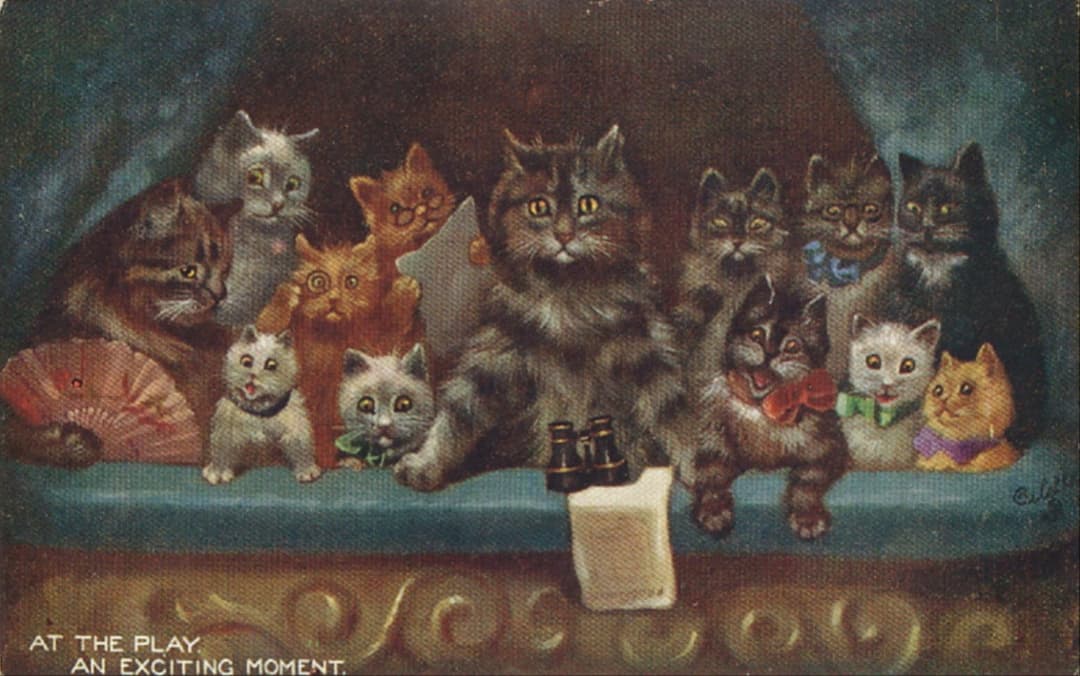
Wain was a young illustrator in London in the 1880s when his wife, Emily, fell seriously ill. To cheer her up, he drew their black-and-white kitten, Peter, in comic poses. Emily encouraged him to show the drawings to editors. In 1886, the Illustrated London News published his Kittens' Christmas Party. Emily died shortly after.
Over the next decades, Wain's cats gradually stood up on their hind legs, put on clothes and moved into a busy little world of their own. They played golf, went to lectures, held concerts and caught every fashionable fad of Edwardian England. Between 1900 and 1940, around 1,100 different Wain postcards were issued by 75 publishers, and his cats turned up on everything from biscuit tins to china.
H.G. Wells put it best: "English cats that do not look and live like Louis Wain cats are ashamed of themselves."
The sad twist is that Wain never copyrighted his work, and barely profited from its success. He spent his last 15 years in psychiatric hospitals and died in 1939. A famous series of his increasingly abstract "kaleidoscope" cats is often told as a neat story of his mind unraveling. But those pictures were found in a junk shop by a psychiatrist who believed art could reveal madness, and other writers have suggested a saner explanation: Wain came from a family in the textile trade and loved intricate pattern. The cats themselves didn't need a tragic legend. They were joyful, and they still are.
The kittens' wedding (we have to talk about it)
Not every chapter of this story is cozy.
Walter Potter was a self-taught taxidermist who ran a museum of curiosities from a pub in Bramber, in Sussex. Starting in the mid-1800s, he built elaborate glass-cased scenes from stuffed animals posed as people. There was a village school with 48 rabbits writing on slates. There was a cricket match played by guinea pigs.
And there was, from 1890, The Kittens' Wedding: twenty kittens in tiny morning suits and brocade dresses, gathered around a feline bride and groom, with a cat vicar in a white surplice officiating.
To modern eyes it's beautiful and deeply unsettling at the same time. To the Victorians, it was a hit, and visitors came to see Potter's museum for generations. When Potter's collection was sold at auction in 2003, it raised more than £500,000, and the artist Damien Hirst reportedly offered £1 million for the lot.
Potter's work is the strange shadow of the whole tradition. It shows how badly people wanted to see animals living human lives, and how far some were willing to go to make it happen.
The dogs who played poker
And then came the most famous animal painting most people have never thought of as art.
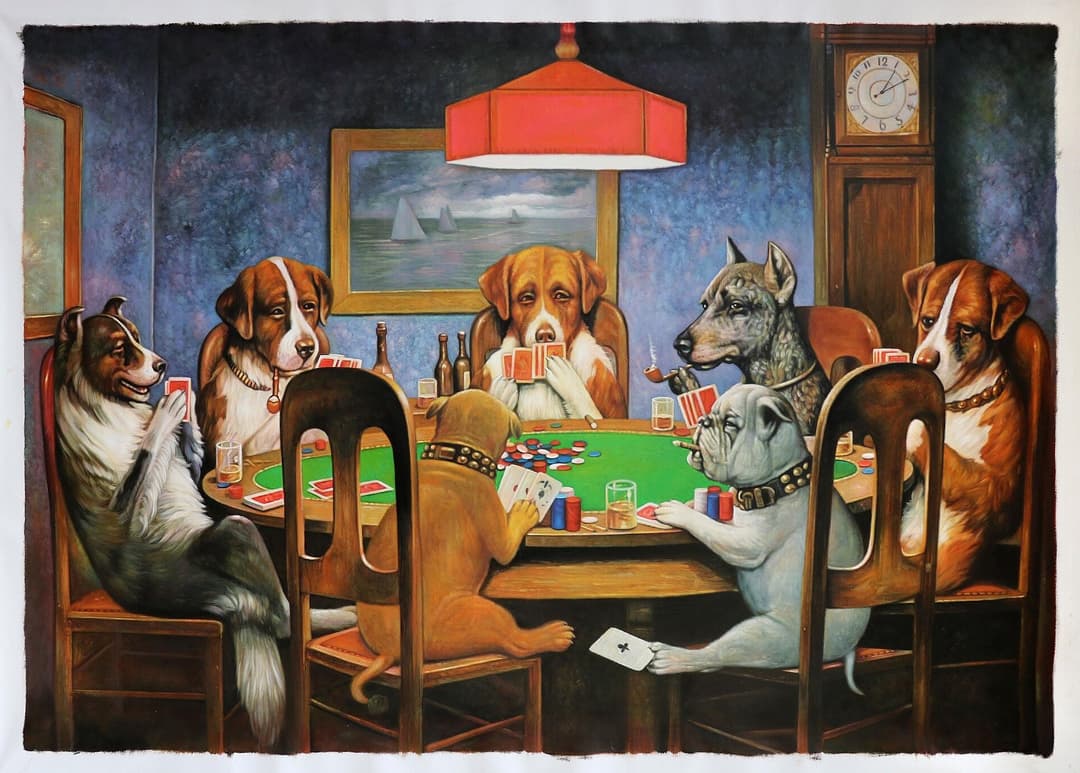
In 1903, the American advertising company Brown & Bigelow commissioned an artist named Cassius Marcellus Coolidge to paint a series of 16 pictures to promote cigars. Many of them showed dogs doing what men did in smoke-filled back rooms: playing cards, smoking, drinking and cheating each other.
The best-known, A Friend in Need, shows a bulldog slyly passing an ace under the table to his neighbor. In another pair, a St. Bernard bluffs his way to the pot holding nothing but a pair of twos.
Critics sneered for a century. One called the image "indelibly burned into the American collective-schlock subconscious." But the public never stopped loving them, and the market eventually agreed. In 2005, two of the originals sold together at auction for $590,400. Ten years later, an earlier Coolidge poker painting fetched $658,000.
Coolidge's dogs weren't anyone's pets, but they did something important: they made dressing animals as people a mass-market joke, printed on calendars and hung in basements across America.
From Polaroids to your phone
The 20th century brought cameras, and with them, real pets in real costumes.
In 1970, a young American artist named William Wegman adopted a Weimaraner and named him Man Ray. Wegman began photographing him, then dressing him up, and the results turned into a career. Later, his Weimaraners Fay Ray and her puppies appeared in costume on Sesame Street, introducing a whole generation of children to dogs as deadpan actors.
After that, the tradition simply went everywhere: greeting cards, calendars, Halloween costumes and eventually the internet. By the late 2010s, "royal" pet portraits, with a dog or cat painted as a duchess, general or Renaissance noble, had become a popular online trend in their own right.
The latest chapter is digital. Today, a photo of your cat can become a portrait of a Napoleonic general in minutes rather than months. Full disclosure: this is what we make here at Furface Studio, so we're hardly neutral. But it's hard to look back at Landseer's poodle judge, or the Duke of Devonshire asking to have his spaniel painted in, and not feel that we're just the newest people in a very old line.
Why do we keep doing this?
Three hundred years of monkeys in wigs, dogs in courtrooms and cats at tea parties suggest something about us.
Part of it is comedy. A dignified costume on an undignified animal is funny, and always has been.
Part of it is the old trick from the monkey paintings: animals let us laugh at ourselves. A poodle as Lord Chancellor says something about lawyers that would be rude to say directly.
But mostly, it's love. Anyone who lives with a dog or cat knows it has a personality, and that personality often seems far too big for the animal. The bloodhound really does look like a retired judge. The terrier really does look like it's planning something. Putting them in a crown or a uniform isn't really dressing them up. It's admitting who we already think they are.
If you'd like to see what your own pet's inner duke, admiral or rock star looks like, you can start with our Royalty Renaissance portraits or browse every design. Queen Victoria would have approved. Probably of all 55 dogs.
Sources
- Cooper Hewitt, Smithsonian Design Museum (2019). Monkey business, French style.
- The Victorian Web. Queen Victoria's dogs.
- Wikipedia. Laying Down the Law (painting).
- DogNews (Nick Waters). Landseer's paintings reproduced as engravings.
- The Spectator. How crazy was Louis Wain?
- Wikipedia. Walter Potter.
- Wikipedia. Dogs Playing Poker.
- The New York Review of Books (2022). Wegman's world.
The historical artworks shown are in the public domain, via Wikimedia Commons. The opening image and the timeline are modern illustrations.
Ever wondered how your pet would look in a portrait?
Try it free with any of our designs and see the result in about 60 seconds.
Browse designs →