






Cats Joined Us Nearly 10,000 Years Ago. So Why Did They Reach Europe So Late?
A cat was buried beside a person on Cyprus 9,500 years ago. So why, according to new DNA studies, did house cats only reach mainland Europe with the Romans, and China in the Tang dynasty?
Furface Studio · October 12, 2026 · 9 min read

About 2,000 years ago, a cat lived and died at a Roman fort on the Danube, in what is now the town of Mautern in Austria. Its skull survived. In 2025, geneticists read its DNA and found it belongs among the earliest domestic cats yet identified on the European mainland.
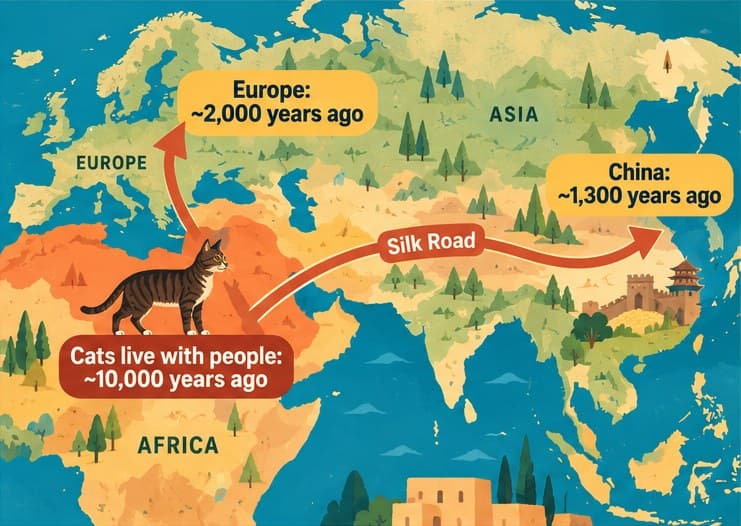
That sounds unremarkable until you set it against the rest of the timeline. Cats were living alongside people nearly 10,000 years ago. One was buried next to a person on Cyprus 9,500 years ago. Egyptians were painting, worshiping and mummifying cats long before Rome had an empire. Yet according to the newest genetic evidence, the house cat didn't settle into mainland Europe until Roman times, and didn't reach China until the Tang dynasty, roughly 1,300 years ago.
Dogs had followed people across most of the inhabited world thousands of years earlier.
So the interesting question isn't how cats conquered the world. It's why the conquest took so long, and what that delay tells us about the unusual way cats became ours.
A deal nobody signed
The story starts with grain. When people in the ancient Near East began farming and storing crops, they built the perfect mouse habitat: piles of food, sheltered corners and trash heaps. Mice moved in. And where there were mice, there was a reason for the African wildcat, Felis lybica, to come closer.
Nobody had to invite it. Researchers call this kind of relationship commensal: a wild animal starts living off resources that people create, and the two species get used to each other long before anyone controls who breeds with whom. Over many generations, the cats that could tolerate noise, smoke and footsteps had the best hunting. People, for their part, could put up with an animal that ate the pests in their stores. Some may have encouraged them. Others probably didn't think about them at all.
Where exactly this began is now less settled than it looked a few years ago. Genetic studies have long pointed to the Near East, the band of early farming land running from the Levant to Mesopotamia. A large 2025 study, the same one that dated the Mautern cat, argues that the cats which eventually spread into Europe came from North Africa, possibly drawn from several wildcat populations there. The African wildcat lives across both regions, so both camps may be partly right. The honest answer for now is "somewhere in that wide arc, possibly more than once."
A cat in a grave on Cyprus
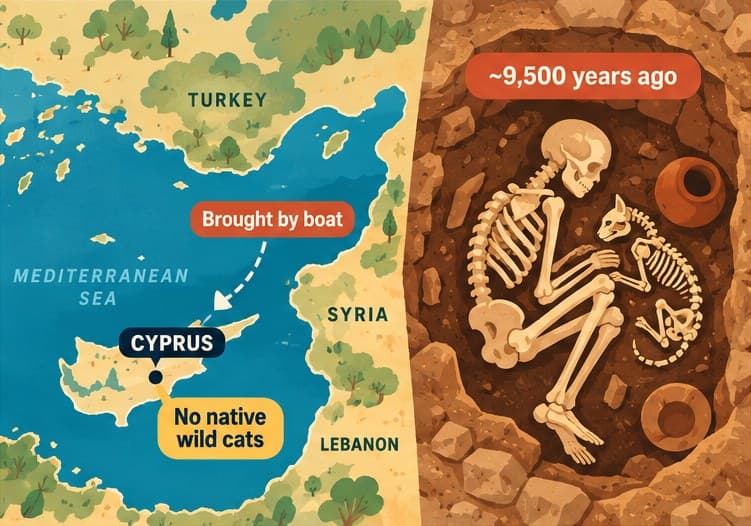
In 2004, French archaeologists reported a find from Shillourokambos, a farming village on Cyprus. A person had been buried with polished stones, flint tools, seashells and ocher. About 40 centimeters away lay a cat, roughly eight months old, buried whole.
Two details make this grave remarkable. First, its age: about 9,500 years. Second, its location. Cyprus has no native wild cats. Every cat on the island had to be brought across the sea by people, in Stone Age boats, at a time when making that crossing at all was a serious undertaking. Someone thought a cat was worth the space.
"The deliberate interment of this animal with a human makes a strong case that cats had a special place," the archaeologist Melinda Zeder told National Geographic when the find was announced.
What the grave can't tell us is what that special place was. The cat may have been a companion, a symbol or something we'd find hard to recognize. It doesn't prove cats were household pets in our sense, and it doesn't make this the first pet cat. It does prove that people were carrying cats over open water more than seven thousand years before the Mautern cat reached the Danube.
Egypt makes the cat famous
If Cyprus shows cats were valued early, Egypt shows how far that value could go. Over thousands of years, cats became fixtures of Egyptian art and religion, closely tied to the goddess Bastet. Egyptians mummified enormous numbers of them, many as offerings at temples.
It's tempting to make Egypt the birthplace of the house cat. The evidence doesn't support that. The Cyprus grave is thousands of years older than Egypt's best-known cat evidence. What Egypt seems to have done is make cats culturally central and, through trade, spread them. A 2017 ancient-DNA study found two waves in the cat's past: an early one linked to Near Eastern wildcats, and a later one, with cats carrying an Egyptian maternal lineage, that spread widely around the Mediterranean in Classical times along trade and shipping routes.
That second wave is where the story takes its most surprising turn.
Europe's missing cats
For years, the standard account went like this: domestic cats arrived in Europe with the first farmers, about 6,000 to 7,000 years ago, moving west alongside wheat, sheep and pottery. Ancient cat bones from places like Poland and Bulgaria seemed to back that up. A 2018 study found cats in Neolithic Central Europe carrying maternal DNA from the Near East.
Then, in November 2025, a team led from the University of Rome Tor Vergata published a far bigger dataset in Science. They screened remains of 225 cats from 97 sites across Europe and Anatolia and produced 87 genomes from ancient and modern cats. Unlike the earlier work, which mostly read a single maternal line of DNA, they looked across whole genomes.
Their conclusion: many of Europe's supposed early domestic cats were actually European wildcats. The bones of wild and domestic cats look very similar, and the two can interbreed, so mixing them up is easy. When the team looked for cats genetically like today's house cats, they found them arriving on the mainland only about 2,000 years ago, in Roman times, probably from North Africa and probably by ship. The Mautern skull is one of the earliest.
There's a strange footnote, too. A cat from Genoni, Sardinia, dating to the second century BC, matches the wildcats that still live on the island today, and its DNA links it to North African wildcats. Sardinia, like Cyprus, has no native wildcats of its own. People seem to have ferried wild North African cats across the sea. Their descendants have been living wild on the island ever since.
This is one study, though a large one. It challenges the earlier picture rather than closing the case, and more ancient genomes from more places could shift the dates. But for now the best genetic evidence says the European house cat is a relative newcomer.
China's other cat
China tells a parallel story, with a twist.
Small cats show up at Chinese farming villages more than 5,000 years ago, hunting rodents around stored grain. It's the same deal as in the Near East. But a 2025 study in Cell Genomics, led by Luo Shujin at Peking University, confirmed that these weren't house cats at all. They were leopard cats, a separate wild species native to Asia.
Leopard cats lived alongside Chinese farmers for about 3,500 years. Then, around the end of the Han dynasty, about AD 200, they vanished from the record. After a gap of several centuries, a different cat appears. The earliest confirmed domestic cat in China comes from Tongwan City in Shaanxi, dated to between AD 706 and 883. Its genome suggests a short coat that was white or partly white. Its maternal ancestry traces back to Near Eastern wildcats, and cats of the same period from Kazakhstan carry matching DNA. The likeliest route is the Silk Road. The researchers suggest these cats may have arrived as prized exotic animals, possibly as gifts for the elite, before becoming ordinary.
The leopard cat story matters because it's a natural experiment. The same opportunity, grain stores full of mice, existed in China for thousands of years. A wild cat took advantage of it. And it never became domesticated. Living near people, it turns out, isn't enough on its own.
Why so slow? Look at the job description
No study has yet explained why house cats took so long to spread. But comparing them with dogs suggests a reasonable answer. What follows is an informed guess, not a finding.
A dog's usefulness travels. Hunting, guarding and herding all work wherever people go, so dogs went with nomads, hunters and migrating families from the start. A cat's usefulness is tied to a place: the granary, the storehouse, later the ship's hold. Cats are also territorial animals that don't take naturally to being herded down a road. For a cat to cross a continent, it helps if there's an unbroken chain of grain stores and harbors along the way.
That chain is exactly what the Roman Mediterranean and the Silk Road provided. The Roman world shipped grain in bulk from North Africa and Egypt to Italy, while Tang-era China sat at the end of a trade network stretching to the eastern Mediterranean. In both cases, the house cat shows up after the infrastructure does.
This difference also helps explain the cat's light-touch domestication. Dogs were selected, over thousands of years, for very different jobs, which is part of why dogs today range from Chihuahuas to Great Danes. (We explored what might happen to all that variety in What Would Happen to Dogs If Humans Disappeared Tomorrow?) Cats were mostly kept for one job they could already do. People didn't need to redesign them. Most of today's pedigree cat breeds are a recent invention by comparison: the first organized cat show was held in London in 1871, and the majority of modern breeds took shape after that.
None of this means cats escaped domestication. House cats are genetically and behaviorally different from their wild ancestors. People moved them, fed them, buried them, worshiped them and eventually bred them for looks. It's just that for most of the story, the cat was holding up its end of the deal by being what it already was.

The deal still holds
Look at a cat asleep on a windowsill and you're looking at the end of a very long, very slow journey. Its ancestors hunted mice around the first grain stores. Some were carried to Cyprus in Stone Age boats. Others became sacred in Egypt. Its own line probably crossed the Mediterranean in a Roman-era ship, or plodded east along the Silk Road in a merchant's cage.
At every step, cats traveled on human infrastructure, but they didn't change much to do it. That's the real lesson of the cat's late arrival. Domestication doesn't always mean an animal being remade to order. Sometimes it means an animal finding a niche we built, and waiting until we built enough of them to carry it around the world.
Sources
- De Martino, M. et al. (2025). The dispersal of domestic cats from North Africa to Europe around 2,000 years ago. Science.
- SNSB (2025). Later than expected: domestic cats arrived in Europe only 2000 years ago. Press release on De Martino et al.
- Luo, S.-J. et al. (2025). The late arrival of domestic cats in China via the Silk Road after 3,500 years of human–leopard cat commensalism. Cell Genomics.
- Ottoni, C. et al. (2017). The palaeogenetics of cat dispersal in the ancient world. Nature Ecology & Evolution.
- Baca, M. et al. (2018). Human-mediated dispersal of cats in the Neolithic Central Europe. Heredity.
- Vigne, J.-D. et al. (2004). Early taming of the cat in Cyprus. Science.
- National Geographic (2004). Oldest known pet cat? 9,500-year-old burial found on Cyprus.
- Driscoll, C. A. et al. (2007). The Near Eastern origin of cat domestication. Science.
- Nilson, S. M. et al. (2022). Genetics of randomly bred cats support the cradle of cat domestication being in the Near East. Heredity.
- Kurushima, J. D. et al. (2013). Variation of cats under domestication: genetic assignment of domestic cats to breeds and worldwide random-bred populations. Animal Genetics.
- Bergström, A. et al. (2020). Origins and genetic legacy of prehistoric dogs. Science.
The images in this article are illustrations, not photographs or reconstructions of specific places. Maps show broad patterns, not exact routes.
Ever wondered how your pet would look in a portrait?
Try it free with any of our designs and see the result in about 60 seconds.
Browse designs →