



If We Take Our Dogs and Cats to Mars, What Will They Turn Into?
People love to guess what humans might become on Mars. Nobody asks about the dog. So we did, with real science and a few wild guesses.
Furface Studio · October 12, 2026 · 7 min read
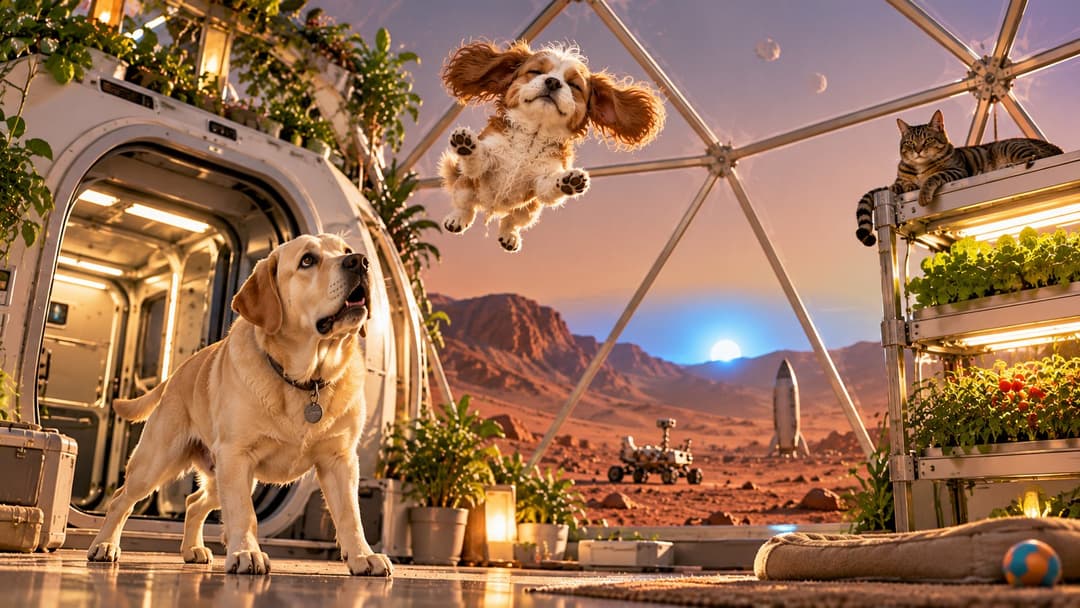
A thought experiment. The science is real; the predictions are educated guesses.
Every few months, someone publishes a breathless piece about what humans might evolve into on Mars. Taller? Paler? Bigger-eyed? Strangely good at spreadsheets?
Nobody ever asks about the dog.
This is an oversight, because the dog is definitely coming. Humans have never gone anywhere without dragging animals along. We took cats across the Mediterranean on Roman ships and along the Silk Road in merchants' cages. We took dogs to every continent, including, briefly and very much against their will, Antarctica. If people ever settle Mars for real, somebody is going to smuggle a terrier onto the rocket.
So let's ask the question properly. Take some dogs and cats to Mars. Leave them there for a thousand years. What comes out the other end?
First, the bad news about Mars
Mars is not a nice place for a Labrador. The air is less than 1% as thick as Earth's, mostly carbon dioxide, and the average temperature is around −60°C (−80°F). Step outside without a suit and your dog wouldn't evolve. It would just stop.
The radiation is also a problem. Mars has no global magnetic field and barely any atmosphere to block cosmic rays. NASA's Curiosity rover measured a dose of about 0.67 millisieverts a day on the surface, many times what we absorb on Earth.
Which brings us to the most important point in this whole article: Martian dogs won't adapt to Mars. They'll adapt to the inside of a building.
Every dog on Mars would live in a sealed habitat, probably partly underground for radiation shielding. No wind, no weather, no squirrels. The forces that would shape them over the generations are the forces of indoor colony life: small spaces, scarce food, artificial light and lots of people in close quarters. Even the day is different. A Martian day lasts about 24 hours and 40 minutes. The dog won't care, as long as dinner still arrives once per day.
And there's one genuinely alien thing no wall can keep out.
The one thing the walls can't fix: gravity
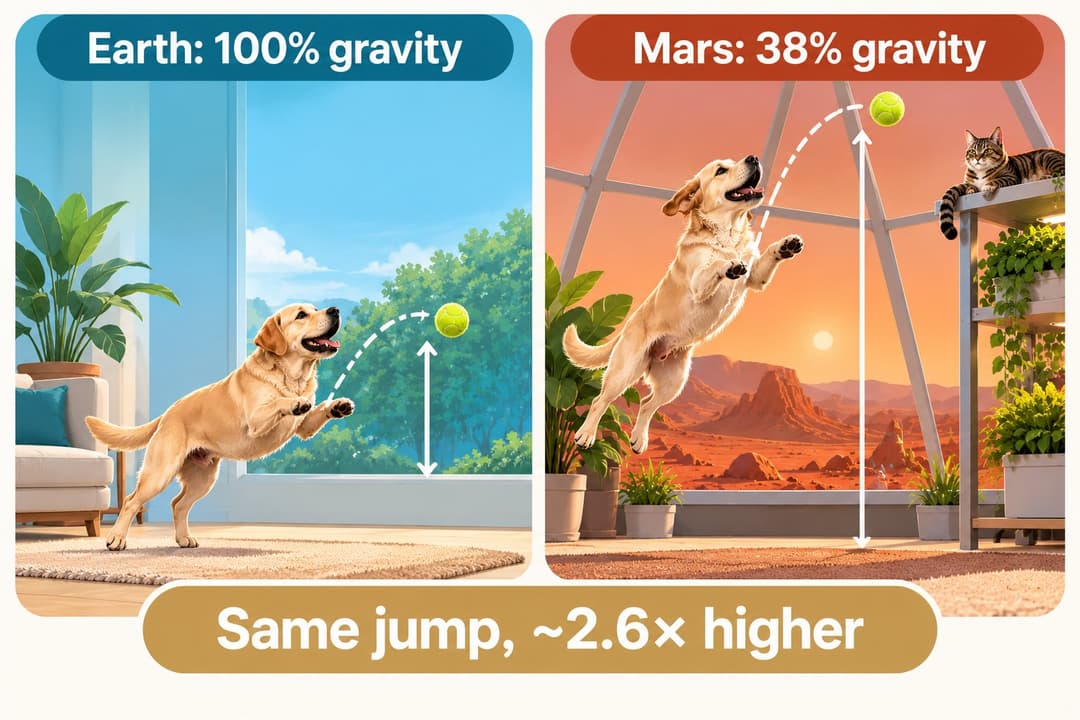
Mars has 38% of Earth's gravity. A 30-kilogram dog would weigh what an 11-kilogram dog weighs at home.
The immediate result would be pure joy. With gravity at 38%, the same push sends a body about 2.6 times as high. Your dog's best leap for a ball would suddenly clear a kitchen table. A thrown ball would also go much farther. Fetch would be transformed, right up until the ball bounced off the dome.
Cats, meanwhile, would achieve their final form. There would be no shelf on Mars a cat couldn't reach.
We even have a hint of how animals react to reduced gravity: they seem to enjoy it. When NASA sent mice to the International Space Station, the younger ones started running laps around the walls of their cage within about a week, a behavior the scientists called "race-tracking." It soon became a group activity. Nobody knows exactly why. We like to think it was joy.
Cats haven't always taken it as gracefully. In 1947, the U.S. Air Force filmed kittens flailing in microgravity during research flights, an experiment that later helped inspire techniques astronauts used to turn themselves around. Mars wouldn't be weightless, though, so a Martian cat would still land on its feet. Just more slowly, and from much higher up.
The long-term bill for low gravity
The fun has a cost. Bones and muscles are built to fight gravity, and when there's less to fight, the body stops paying for them. On long space station missions, astronauts have lost, on average, 1% to 1.5% of the bone density in their hips and spine every month.
Nobody knows what 38% gravity does over a whole lifetime, let alone over generations. It's entirely possible Martian dogs would gradually develop lighter skeletons, because a heavy one would be wasted effort. That's a guess, not a finding. But if it happened, it would come with a catch. A dog born on Mars might find Earth crushing, the way an astronaut does after months in orbit. The first Martian dog to visit Earth could need a very long nap.
Mars is an island, and islands shrink things
To predict what happens to a population stuck somewhere small, biologists look at islands. Islands do strange things to animals.
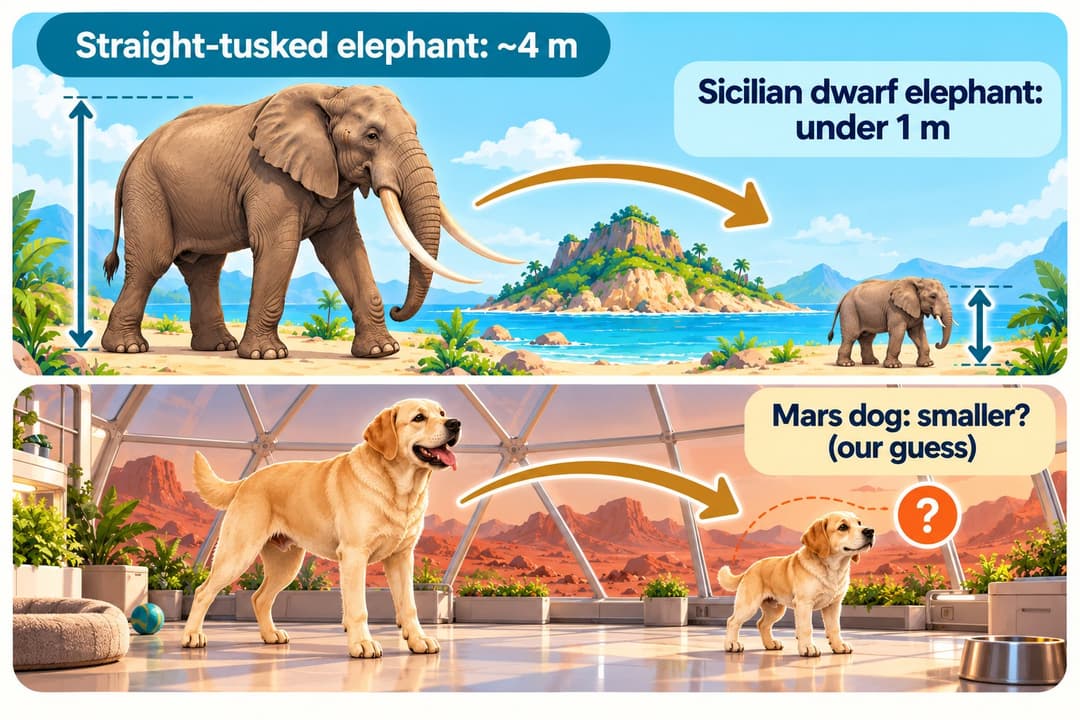
The classic example comes from the Mediterranean. Hundreds of thousands of years ago, straight-tusked elephants roughly 4 meters tall reached Sicily. Their descendants shrank and shrank, until the adult males of the dwarf species stood under a meter at the shoulder. That's an elephant you could look down on. Large animals on islands often shrink, because a limited food supply punishes anything that needs too much of it.
A Mars colony is the most extreme island imaginable. Every calorie your dog eats would have to be grown under lights, in soil that had to be manufactured, inside a building that had to be flown across space. A Great Dane on Mars wouldn't be a pet. It would be a budget crisis.
In practice, this is where evolution gets overtaken by committee. Natural selection would favor small dogs over thousands of years. Colonists would favor them by next Tuesday. Humans have been choosing which dogs get to breed for thousands of years, and on Mars the deciding vote would belong to the colony's food planners. The Martian dog would be small because a spreadsheet said so.
A calmer kind of dog
Then there's personality. A dog that barks at every noise, digs at every floor and panics in tight spaces would make life in a sealed dome miserable for everyone. Colonists would breed the calm ones, and we know how fast that can change an animal.
In 1959, Soviet scientist Dmitry Belyaev began breeding silver foxes, selecting only the ones that were least afraid of people. Within a few generations, the foxes were noticeably tamer. Over the following decades, some began wagging their tails, whimpering for attention and seeking out humans. And some started to look different too, with floppy ears, curlier tails and patchy coats, even though nobody had selected for looks at all. (Later researchers have debated how much of that change was new and how much was already hidden in the fur-farm foxes Belyaev started with. But the speed of the behavioral change is hard to argue with.)
A dog generation is a few years, so a thousand years on Mars would mean a few hundred generations. That's plenty of time for colonists to breed a dog that's small, placid and happy to spend its whole life indoors. Possibly with floppier ears than it started with.
The cat gets its old job back
Cats, as always, have a better plan.
When cats first moved in with people around 10,000 years ago, it wasn't for the cuddles. Farmers stored grain, grain attracted mice, and mice attracted cats. (We told that story in Cats Joined Us Nearly 10,000 Years Ago. So Why Did They Reach Europe So Late?) Now picture a Mars colony: greenhouses full of crops, food stores, warm hidden corners. Mice have stowed away on almost every kind of ship humans have ever built. Sooner or later, one will stow away to Mars.
At which point the cat, after 10,000 years of mostly lying on things, would be needed again. Humanity's oldest pest-control arrangement would start all over, 225 million kilometers from where it began.
So what does a Martian dog look like?
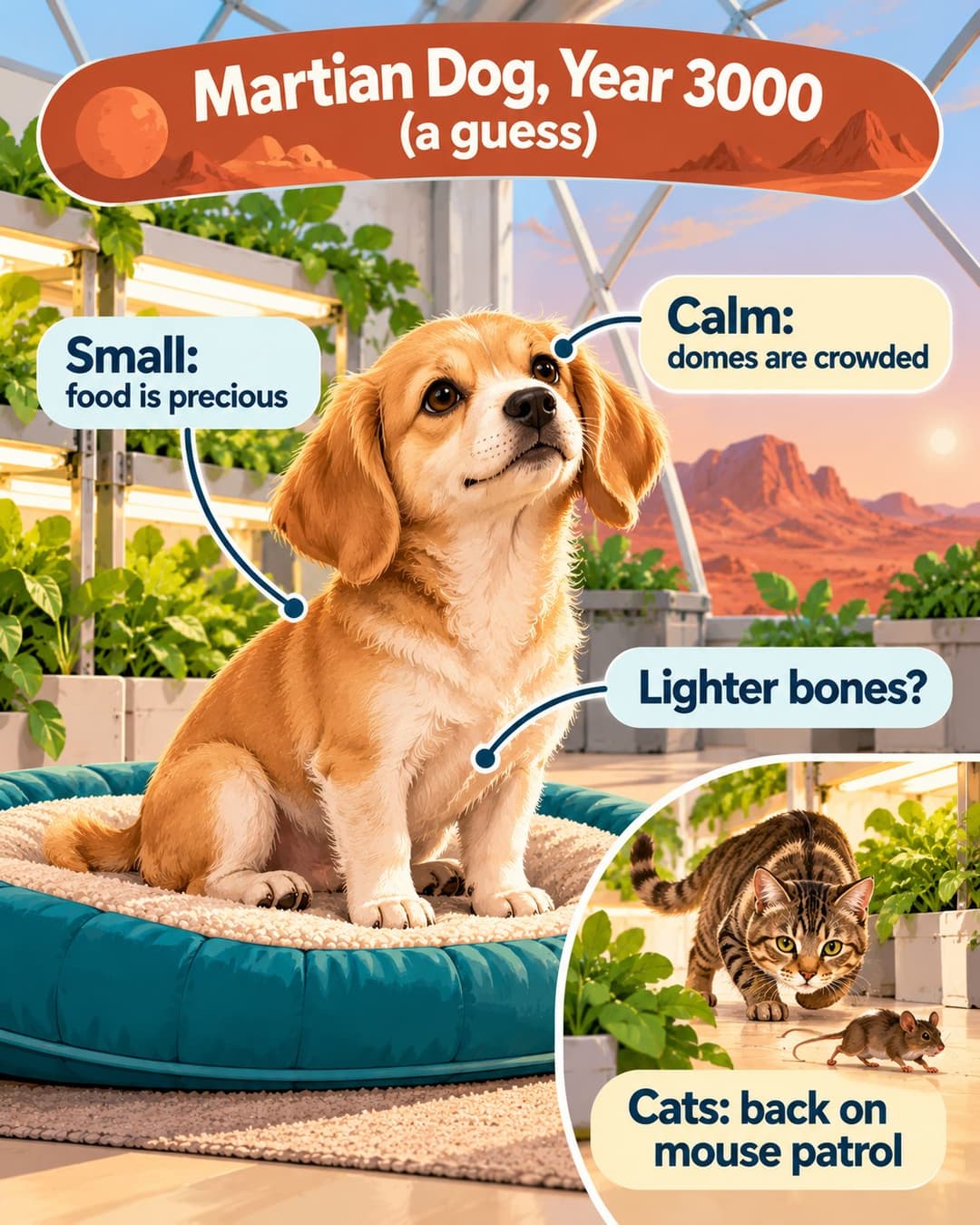
Put it all together and here's our best guess at a dog, a thousand years into the Martian experiment. Remember, this is speculation, not a prediction:
- Small, because food is precious and space is tight.
- Calm and sociable, because a dome is no place for a nervous barker.
- Possibly lighter-boned, if low gravity stops rewarding a heavy skeleton.
- Completely indifferent to the weather, because it has never experienced any.
It wouldn't be a sleek alien super-hound with radiation-proof fur. Radiation causes random damage, not superpowers, and evolution doesn't hand out upgrades on request. The real Martian dog would be something much more ordinary, and much more touching: a small, gentle, slightly floppy-eared homebody that has never seen a blue sky or chased a squirrel.
It would still steal food off your plate, though. Some things are older than Mars.
Why bother wondering?
Because the question isn't really about Mars. Every dog on your sofa is already the product of exactly this kind of process: a wild animal reshaped by the places we took it, the food we gave it and the choices we made about which dogs got to have puppies. Chihuahuas and Great Danes exist because people kept making those choices, slowly for thousands of years and then very fast over the last two centuries.
Mars would simply run the experiment again, in a much smaller room, with much less gravity. The dogs wouldn't mind. They never have. As long as we were going, they'd want to come too.
Can't wait a thousand years? Our Sci-Fi collection will put your pet in a spacesuit today.
Sources
- Hassler, D. M. et al. (2014). Mars' surface radiation environment measured with the Mars Science Laboratory's Curiosity rover. Science. Summarized by Southwest Research Institute.
- NASA. Risk of spaceflight-induced bone changes.
- NASA (2019). Studying behavior in space shows mice adapt to microgravity.
- Popular Science. Why did the Air Force play with cats in space?
- Palaeoloxodon falconeri, the Sicilian dwarf elephant. Summary and size estimates.
- Yale Scientific (2018). How to tame a fox and build a dog.
- Trut, L. N. (1999). Early canid domestication: the farm-fox experiment. American Scientist.
- Lord, K. A. et al. (2020). The history of farm foxes undermines the animal domestication syndrome. Trends in Ecology & Evolution.
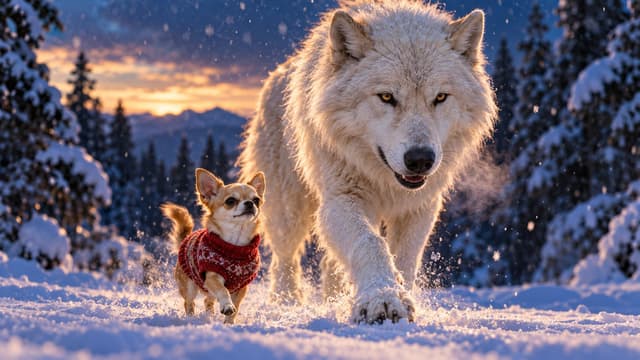
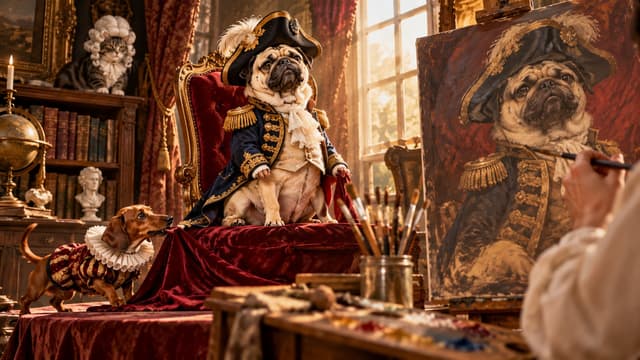
The images in this article are illustrations. Nobody has taken a dog to Mars yet.
Ever wondered how your pet would look in a portrait?
Try it free with any of our designs and see the result in about 60 seconds.
Browse designs →